

Huntsville’s Twickenham is north Alabama’s best residential historic district

Historic places tourism in the Rocket City’s top historic district
Downtown Huntsville, Alabama, has one of the highest concentrations of interesting historic landmarks in the South, many of which are from the first half of the 19th century. The Twickenham Historic District’s visual appeal is one of the top reasons a historic sightseeing trip to the city is a great Southern outing.
Before Huntsville was officially named Huntsville, Leroy Pope led efforts to name it Twickenham after the suburb of the same name in London where his renowned relative — 18th-century poet Alexander Pope — resided. Prior to that, the settlement known as Hunt’s Spring existed here where John Hunt built a cabin in 1805.
In 1809, the Mississippi Territory House of Representatives passed legislation that allowed for the platting of the town, along with authorization to build some government buildings and auction the land. The legislative act included the name Twickenham. But in 1811, the rapidly growing town was incorporated as Huntsville as a majority preferred naming it in honor of Hunt. It was the first incorporated town in the Alabama Territory.
Pope purchased a large portion of the land in the new town and built a mansion at the top of what is now known as Echols Hill.


Shown above: The c. 1814 Leroy Pope Mansion; remodeled 1834
The district’s 2015 update and boundary increase application to the National Register of Historic Places provides an incredibly-detailed description.
Once you’re in downtown Huntsville, you can get to Twickenham from any direction and from several streets, but I like to start at the southeast corner of the public square. At that corner you will find the three-story now labeled as the David L. Thomas Building. It was built in 1836 but has been remodeled two or three times. It’s a good reference point whether on foot, on bike or in a car. Almost 90% of the district is found within the right angle this corner forms with Eustis Avenue and Franklin Street.

David L. Thomas Building
Walk, ride or drive into the district and you’ll discover an area of about 12-blocks filled with alluring streetscapes, and fascinating history. While there are a few museums, churches, businesses and other buildings in and on the edge of the district, most the places contributing to Twickenham’s historical significance are private homes.
A large number of well-preserved houses that are between the ages of 175 and 210 years old are found here ranging from small two-room, two-story frame houses with small yards to gated estates with yards of 15-acres or larger. Many of them can be easily viewed from the sidewalk. Almost every house and yard are very well-kept. Landscaping is professionally done throughout, and there are some jaw-dropping private gardens.


Above: The c. 1825 Yeatman House, birthplace of Brigadier Gen. John Greenway and the Walker-Lowe House, also known as Westlawn (1834).
You could pick almost any street in Twickenham and enjoy a sidewalk tour that you would not soon forget. If you could only visit one, Franklin Street would be a good choice. Here’s a few of the Franklin Street properties:


Pictured above, from left: picture 1) c. 1892 Whitten-Everet House, c. 1821 Bradley House and c. 1850 Bibb Bradley House; picture 2) c. 1902 Van Valkenburg House; 3) c. 1819 Mastin-Batson House; 4) c. 1820 Fearn-Garth Home; 5) c. 1826 Morgan-Neal Home; 6) c. 1818 Albert Erskine House; 7) c. 1892 Betts House; 8) c. 1928-29 house; 9) c. 1829 Benjamin S. Pope House; and 10) c. 1818 Grove-Bassett House.
Franklin Street may be the flattest part of Twickenham. On it’s east/northeast side, Echols Hill provides an elevation rise of up to 80 feet. The hill enhances the views in several spots, but it can make a walking or biking tour more challenging.
These two fine 19th-century homes sit side-by-side on the slope of Echols Hill on Adams Street:


Pictured: The c. 1848 McDowell House and the c. 1826 Moore-Rhett House.
At the corner of Gates Avenue and Green Street, the c. 1819 Weeden House is open to the public as a museum for very specific hours, or by appointment. It’s also a wedding venue.
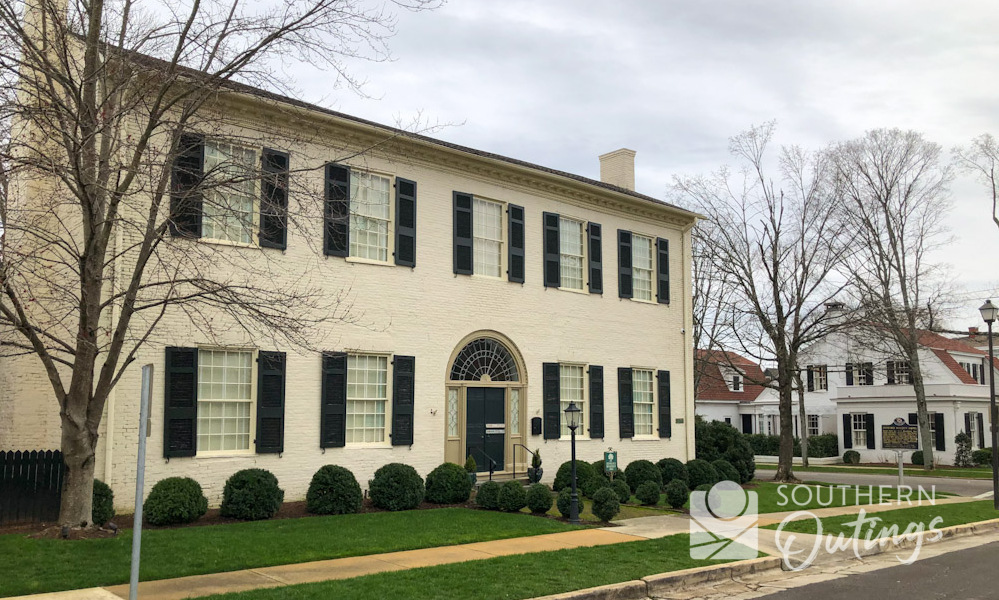
Circa 1819 Weeden House
Three historic churches are within the district:
- The Church of the Nativity, Episcopal, c. 1859
- The First Presbyterian Church, c. 1860
- First United Methodist Church, c. 1874
Another historic church, the c. 1884 Randolph Street Church of Christ, is just a few feet outside of the official Twickenham Historic District boundary across from the Methodist Church.


Shown, from top left: The Church of the Nativity, Episcopal, c. 1859; First United Methodist Church, c. 1874; the c. 1884 Randolph Street Church of Christ; and the First Presbyterian Church, c. 1860.
Williams Avenue is another street in the district that could stand alone as a great sidewalk tour. The c. 1836 Thomas Bibb House is found there.

Circa 1836 Thomas Bibb House
FUN FACT: Thomas Bibb was Alabama’s second governor. His brother, William Wyatt Bibb, was the first. Less than a year after being elected governor in 1819, William died in a tragic horse accident. Thomas was the president of the Alabama Senate and became acting governor. He completed his brother’s term but did not seek reelection in 1821.
NOTE: There are a good number of houses that were built since the 1960s-70s, and even a few that were built since the 1990s, that were designed to look like historic houses. Most of them blend in so well from the street that I did not realize, until I got deeper into my research, that they were much younger than I am. Here’s a pair of those:


Pictured: A non-historic home built in 1985, and a home built in 2013 that has the appearance of an early 1880s house.
Here’s a few other houses you’ll see in the amazing Twickenham district:


From top left: The c. 1874 Wharton-Walker-Cash House, remodeled 2002; the c. 1913 Gideon Blackburn House; the side-by-side c. 1826 Cox house and c. 1815 Perkins House; McClung-Bibb House, c.1838, remodeled 1855; and the blue c. 1883 Goldsmith House.
The black and white photos were found on the Library of Congress website, www.loc.gov, and are believed to be public domain.
Sources for this article include the following:
Related National Register of Historic Place applications
huntsvillehistorycollection.org
See also, The top 6 greenways in Huntsville for walking, running and bicycling.